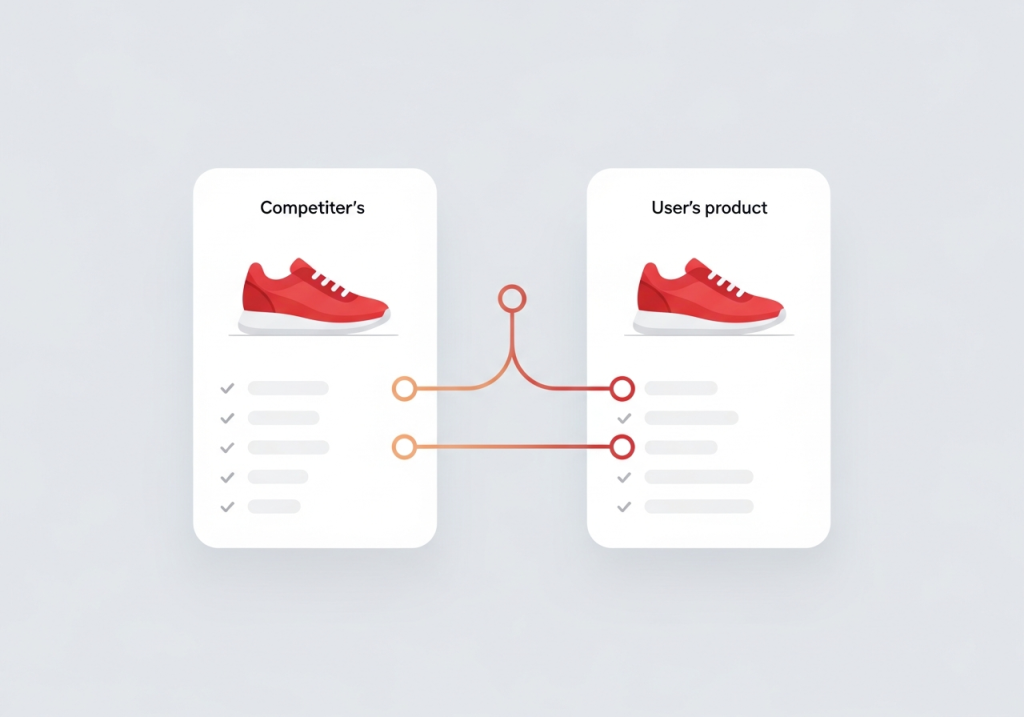
Comparing products manually across the online retail landscape is a messy and time consuming nightmare. You often find competitors listing identical items with completely different names or missing identifiers entirely. This creates a scattered picture of the market that leaves your commercial team guessing about your true competitive standing.
Your business loses significant margins when relying on this flawed manual data. You might end up drastically underpricing your inventory against items that are currently out of stock on a rival site. Alternatively, failing to match competitor catalogues accurately means you miss out on obvious opportunities to increase prices safely. Both scenarios directly harm your profitability and stunt your commercial growth.
Identify products correctly across inconsistent store listings
Retailers often face a frustrating wall of messy data when trying to track the wider market accurately.
Stop losing profit to manual data errors
Disjointed product descriptions and inconsistent listings across webshops create massive hurdles for pricing teams. It becomes nearly impossible to maintain an accurate view of your market standing when every competitor uses unique naming conventions. Your team spends hours trying to figure out if two slightly different titles actually represent the same physical item. This manual digging wastes valuable resources that your staff should spend on overarching commercial strategy.
Relying on manual web link hunting scales poorly as your inventory grows over time. This tedious process leads to outdated competitive data and severely delayed pricing reactions across your storefront. By the time your team finishes mapping a small fraction of your catalogue manually, the market has already moved on to new pricing tiers. You need a reliable system that answers how to match competitor products automatically to keep up with active market changes.
Accurate competitor product matching in eCommerce pricing is the only way to resolve this severe operational issue. Without precise mapping at the core of your strategy, retailers unknowingly base critical pricing decisions on incorrect positioning. They might match against completely irrelevant products and tank their margins by mistake. You must move away from manual website checks to ensure your competitive strategy always reflects reality.
Monitor the full market without human fatigue
Shifting your approach requires understanding how modern systems process vast amounts of retail data without human fatigue.
Replace manual spreadsheets with automated matching
Managing price tracking through basic spreadsheets leaves your team entirely vulnerable to constant naming inconsistencies. Human analysts simply cannot keep up with thousands of daily catalogue updates across dozens of active competitors. This manual bottleneck prevents your business from spotting broader market trends before they negatively impact your online sales. Your team cannot react to market shifts if they are trapped verifying single product names.
Modern matching engines bypass these frustrating naming inconsistencies entirely. They utilise definitive product attributes like European Article Numbers to guarantee precision across all active web listings. Digesting vast amounts of historical big data allows intelligent models to surface market patterns that manual analysts easily miss. Using a product matching AI for pricing tools allows you to access years of structured historical market data instantly.
Accessing this existing layer of historical market intelligence means your business no longer has to build its competitive understanding from scratch. You can simply plug into a system that has already processed the heavy lifting for your commercial team. When searching for the best tools for matching similar competitor products, you must prioritise software that uses unique identifying numbers rather than relying on flawed text descriptions.
Turn market data into immediate commercial action
Taking full control of your market position means implementing systems that turn raw data into direct commercial action.
Adjust prices automatically based on competitor stock
Human reaction times create severe bottlenecks when trying to execute new pricing strategies across a large inventory. Even if you manage to gather accurate market data, applying updates across thousands of products manually takes far too long. Your margins suffer greatly while your team manually adjusts figures one by one in your backend system. Competitors with better infrastructure will always outpace you if you rely on human execution for every single price tweak.
Linking accurately matched catalogue data to rule based repricing ensures prices adapt instantly to market movements without human bottlenecking. Identifying out of stock competitors allows users to set rules that ignore inactive players entirely. This specific tactic protects your margins by preventing your store from racing to the bottom against a retailer who cannot even fulfil the customer order. Competitor product matching is truly valuable only if it triggers these immediate and smart adjustments automatically.
You need dedicated competitor product matching software to handle this execution flawlessly day and night. You can utilise the automated European Article Number integration from PriceShape to align your entire catalogue instantly. The platform uses Penny AI to rapidly structure historical market data into clear insights without requiring constant manual checks. Your team then configures human approved pricing rules within PriceShape to execute targeted strategies safely while protecting profit margins.
Protect margins with reliable market data
Accurate automated matching eliminates reactive guesswork from your daily commercial operations completely.
Focus on growth strategy instead of fixing data
You allow your commercial teams to build structured and margin protecting pricing strategies when you finally remove manual data entry. Removing human error from the matching process gives your team complete confidence in their overall market positioning. They can focus entirely on strategic business growth rather than fixing broken spreadsheets or hunting for missing web links.
Here is what you achieve when upgrading your competitive catalogue mapping process:
- You instantly bypass inconsistent competitor naming conventions across the web.
- You protect vital margins by automatically filtering out competitors with zero stock.
- You execute confident price changes based on exact product matches only.
- You free your commercial team to focus on overarching retail strategy.
Evaluate your current catalogue mapping process today to see exactly where manual errors drain your monthly profits. Explore software that automatically structures your competitive market data for immediate and confident action. Book a demo with PriceShape to see how automated product matching and custom pricing rules will secure your margins and grow your business.