Base pricing decisions on current market reality
In rapidly shifting e-commerce markets, relying on manual spreadsheets for pricing updates creates a dangerous lag between market reality and your storefront. You might spend hours adjusting prices based on data from last week. By the time you publish those changes, your competitors have already moved on.
This delay is costly. Without centralized, accurate competitive data, pricing teams are forced to rely on intuition. This often leads to unnecessary price wars where you sacrifice margin to win sales you would have secured anyway. Conversely, you might miss profit opportunities because you failed to spot a competitor’s stockout. To stay profitable, you need to move from reactive guessing to proactive strategy.
Eliminate blind spots caused by scattered data
As your product catalog grows, manual competitor price monitoring becomes impossible to scale without errors. You might manage fine with fifty products. Once you scale to thousands of SKUs across multiple markets, the sheer volume of data overwhelms even the most dedicated team. You simply cannot visit every competitor URL daily to check their prices. This results in significant blind spots where you are consistently undercut or overpriced without knowing it.
The issue goes deeper than just volume. Retailers often face the challenges of inconsistent product data. One competitor might list a sneaker under its official model name while another uses a descriptive title. Inconsistent data formats and varying naming conventions across retailers make accurate product matching messy and unreliable. If your data collection process cannot match these products correctly via EAN numbers or advanced logic, you are basing your financial decisions on bad data.
Internal organization often compounds these external challenges. Critical data often lives in isolated places. This creates problems with disconnected pricing silos. Your inventory levels sit in your ERP. Competitor moves sit in a spreadsheet. Sales performance lives in Google Analytics. When these metrics are never analyzed together, you make disjointed decisions. You might discount a product to drive sales even though you have low inventory, or you might hold a high price on an item that has stopped selling completely.
Protect margins by analyzing shipping and stock status
Gathering data is only the first step. The real competitive advantage comes from knowing how to use competitive data for pricing decisions that protect your bottom line. True market visibility requires analyzing the total landed cost. This means looking at the product price plus shipping to understand what the customer actually pays. If you only look at the shelf price, you might lower your price to beat a competitor. However, if that competitor charges a high shipping fee, your total offer might already be cheaper. You sacrifice margin unnecessarily because you lacked the full picture of the benefits of shipping cost analysis.
Another critical factor is stock availability. Pricing strategies improve significantly when you understand the competitor stock status impact on price. Retailers often lower prices to compete with rivals who are actually out of stock. This is a mistake. If your competitor cannot deliver the product, you should not lower your price to match them. Instead, you should potentially raise your price to capture the demand they cannot fulfill. Identifying these opportunities allows you to maximize profit on every sale.
Finally, integrating performance metrics helps you identify specific product roles. You can spot “basket openers” that drive traffic versus slow movers that require clearance strategies. This requires a holistic view of your data.
Combine data sources to avoid disjointed decisions
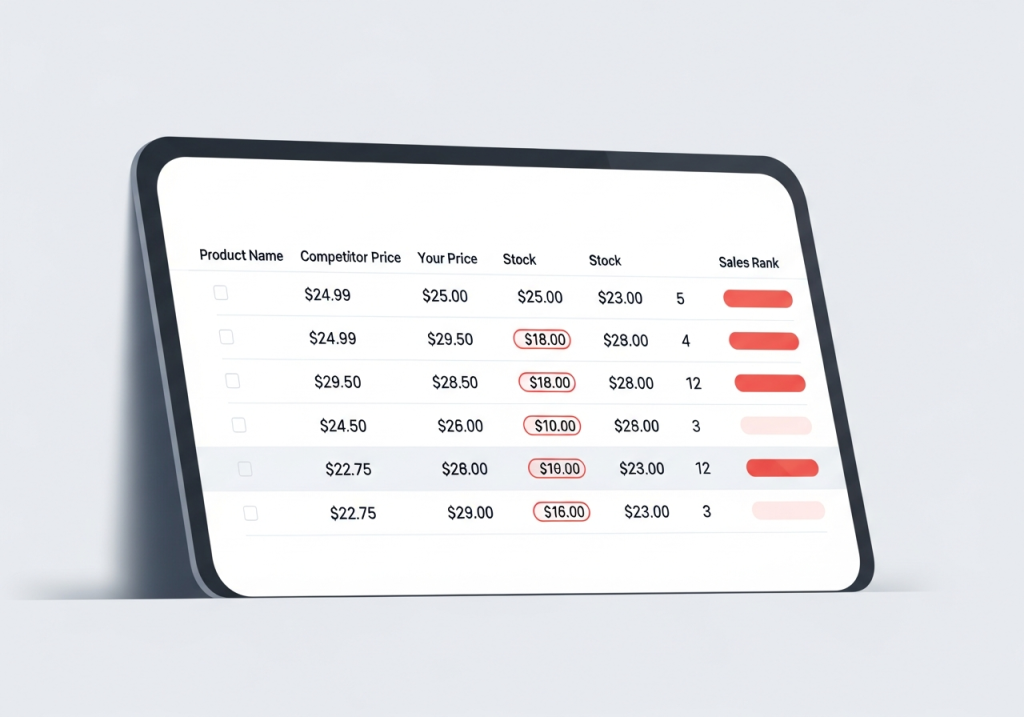
Effective strategy requires the simultaneous visualization of three data points. We call this the “Triangle of Success.” This involves combining your inventory data, your competitor’s behavior, and your product performance data into a single view. When you isolate these metrics, you make mistakes. When you combine them, you unlock intelligent decision-making.
This holistic view prevents disjointed actions. For example, without this triangle, you might aggressively market a product that is out of stock. Or you might drop the price on a bestseller that is already winning the Buy Box. By visualizing all three points, you ensure your pricing strategy aligns with your actual inventory position and real market demand.
Automate pricing rules while maintaining control
To scale these strategies, you need to move away from manual execution. Platforms like PriceShape act as some of the best competitive data tools for retailers by automating the collection and matching of market data. This provides a single source of truth for your commercial teams. Instead of arguing over whose spreadsheet is current, your team operates from a unified dashboard that reflects the market as it stands right now.
Automation does not mean surrendering control to a “black box” algorithm. PriceShape is not a fully AI platform that makes decisions without your knowledge. Instead, your teams use this data to set automated dynamic pricing rules. You define the logic. You might set a rule to always be 5% cheaper than a specific competitor, but only if your margin remains above 20%. The software simply executes the strategy you designed. This ensures that every price change aligns with your business goals.
Set floor prices to prevent a race to the bottom
The ultimate goal of automation is not just revenue, but profit. Effective tools allow you to implement strict margin protection strategies. You can set floor prices to ensure you never sell below cost, regardless of what competitors do. This automation enables real-time reaction to market shifts while strictly enforcing safety nets to prevent a race to the bottom. You stay competitive where it matters and protect your profit where it counts.
Turn raw data into profitable pricing actions
Transitioning from manual checks to automated competitive intelligence turns raw data into confident, profitable pricing actions. You no longer have to guess where you stand in the market. By unifying your inventory, performance, and competitor data, you can execute strategies that drive growth without sacrificing margin.
It is time to stop reacting to the market and start leading it. Evaluate your current pricing workflow today to see where automated data insights can recover lost margin. Book a demo with PriceShape to see how your data can work for you.